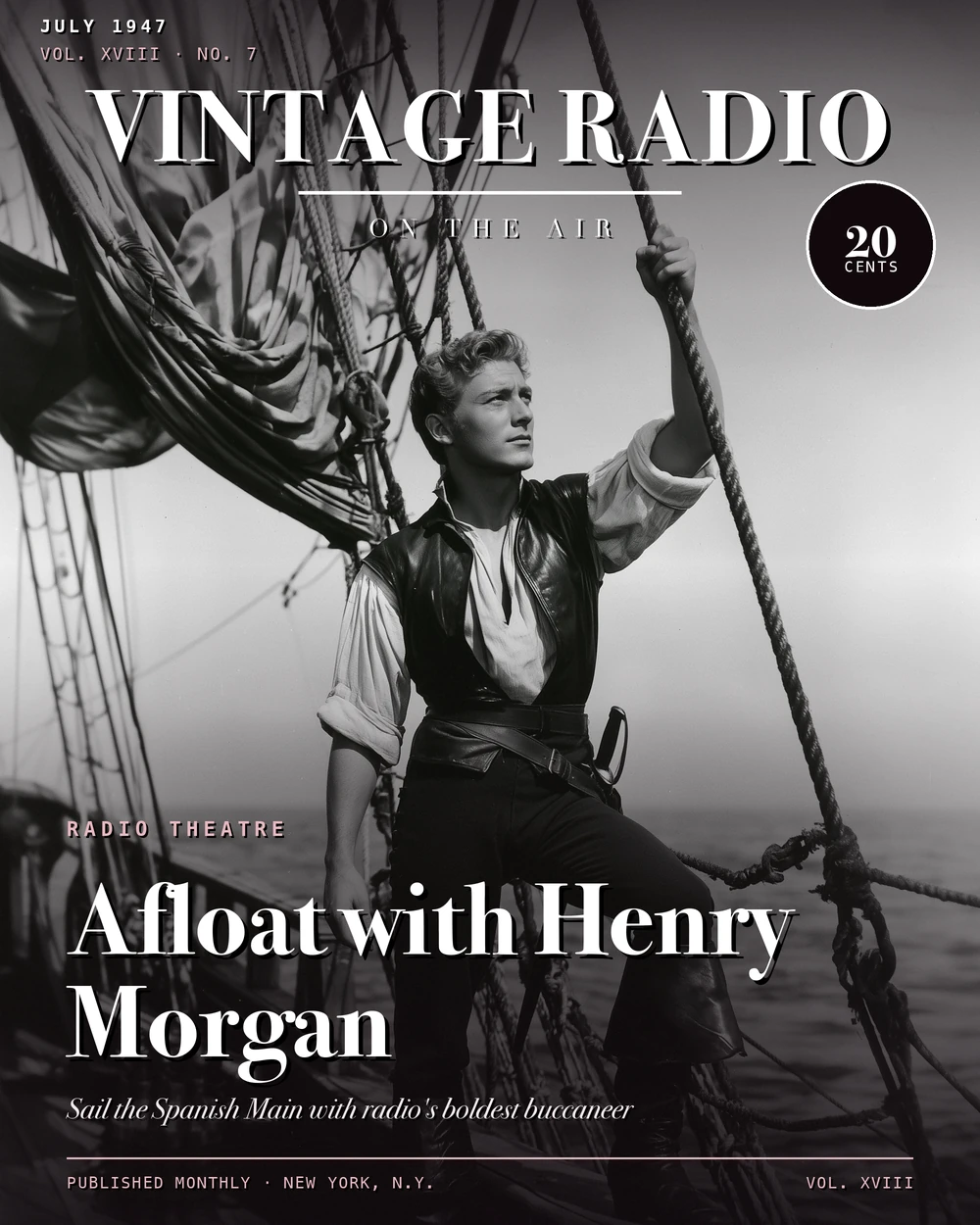
Afloat with Henry Morgan
One Man, a Dozen Characters, and a Stolen Aztec Necklace
The most remarkable thing about Afloat with Henry Morgan isn't the swashbuckling storyline or the piracy themes — it's the fact that the man at the center of it could play a small child, an aged foreign woman, and a grizzled sea captain within the same twelve-minute episode and make them all convincing. George Edwards, born Harold (Hal) Parks on 11 March 1886 in Kent Town, South Australia, was described by his contemporaries as "the man with a thousand voices," and this serial gave him full room to demonstrate why. He starred as Captain Henry Morgan, the historical seventeenth-century buccaneer, while simultaneously voicing an array of supporting characters — the record for a single scene was six distinct voices, and across a full episode he would often double that count.
Edwards had built that skill during a career in vaudeville, but by the early 1930s vaudeville was fading and radio was the new stage. He made the move decisively. In May 1933 he relocated to Sydney with two long-time collaborators — writer Maurice Francis and actress Nell Stirling — and set up shop at commercial station 2GB as the nucleus of the George Edwards Players. The Australian Dictionary of Biography identifies him as a pioneer of the radio serial in Australia, which is a fair description of someone who essentially helped establish the form in his country from the ground up.
When It Actually Aired
The serial is often associated with a 1933 broadcast date, and some early catalog records carry that figure. The picture is more complicated. Australian radio historian Ian Grieve has pointed out that Australia did not begin recording radio programs until the late 1930s, and that Edwards himself did not record any of his shows until around 1938. Grieve states specifically that Afloat with Henry Morgan commenced broadcast on 12 May 1947 — not 1933. A reference to the show in the Sydney Morning Herald dated 18 September 1952 is consistent with a broadcast life well into the postwar period. A certified series compilation qualified the earlier date as "generally thought" rather than confirmed. The upshot is that the surviving 51 episodes most likely come from the late 1940s or early 1950s, whatever the original story's origins may have been.
The serial's story is credited to writer Warren Barry, and the program was distributed as a syndicated production — designed to be picked up by multiple stations rather than tied to a single network run. Each episode ran approximately twelve minutes, a format suited to the youth market the series was probably targeting.
The Story and Its Cast of Characters
The show drew on the historical figure of the real buccaneer Henry Morgan, but the stories were fictionalized. The central plot threads involve a character named Jeffrey, who carries a wronged conviction and spends much of the serial trying to clear his name and locate Morgan. A character named Hero travels alongside Jeffrey, and the two spend time being mistaken for intruders, imprisoned aboard ship, interrogated by a villain named Diatz, and eventually released. Sir Thomas Motford appears as Jeffrey explains his background and his unjust conviction. The Governor of Cuba plays a significant role, and his daughter Dolores becomes a romantic thread — she's connected to an Aztec necklace that Morgan has stolen and that the Governor covets.
Morgan himself is portrayed as a complex antagonist: he attacks and sacks towns (one episode centers on his assault on a place called Santa Pora), imprisons Jeffrey, negotiates deals with the Governor, and yet also releases his captives at key story turns. The serial has the structure of a serialized adventure — each episode's title tells you where the plot has moved, and the cliffhanger logic keeps characters in jeopardy from one installment to the next. Jeffrey's journey — wronged, imprisoned, searching, eventually reunited with Dolores in Havana — is the spine around which Morgan's more explosive adventures run.
Maurice Francis, who co-wrote many of the George Edwards Players' productions, is believed to have contributed to the writing here, and Nell Stirling is thought to have appeared in the cast as well, though the documentation of specific episode credits is incomplete.
The George Edwards Players
Afloat with Henry Morgan was one title in a larger body of work the George Edwards Players produced for Australian radio. The group's catalog ranged from horror adaptations — Dr Jekyll and Mr Hyde, Frankenstein — to adventure serials like Corsican Brothers and Son of Porthos, to the crime procedural Inspector Scott of Scotland Yard, and eventually to the long-running domestic comedy Dad and Dave. Together, these titles suggest a company that was willing to work in almost any genre and adapt whatever material would hold a radio audience.
Edwards's ventriloquial gift was the engine behind most of it. The ability to produce six distinct, believable voices in a single scene — small children, male voices across a wide range, aged women, foreigners — meant that a small company could produce radio drama that sounded much bigger than it was. In a medium defined entirely by what the listener hears, that was a genuine production advantage. Edwards kept working in Australian radio until his death on 28 August 1953 in Petersham, New South Wales.
What Survives
A certified complete version of the series — Version 1.0, dated 1 January 2007 — was released comprising one CD and accounting for all 51 episodes. The research drew on the Australian Dictionary of Biography Online and the work of historian Ian Grieve, whose date correction substantially revised the conventional understanding of when the show aired.
One clarification: the Henry Morgan of this serial is the pirate captain, not the American comedian Henry Morgan, whose own radio program The Henry Morgan Show ran in the United States during the same general era. The names create occasional confusion in old-time radio catalogs, but the two productions have nothing to do with each other. Afloat with Henry Morgan is an Australian adventure serial — syndicated, youth-oriented, built around one performer's extraordinary vocal range, and drawing on a piracy story that mixed historical figures with fictional invention. It represents a particular kind of early broadcast production, made under constraints that would surprise modern listeners, by a small company that found ways to make the limits work.